Why Are My Toenails Thick and Hard? Causes and Daily Foot Care
| The main answer | Why are my toenails thick and hard? Toenails thicken for everyday reasons — age, tight shoes, repeated minor trauma, poorer circulation and sometimes fungus — usually building up slowly over months. |
| Fungus or not | Not always fungus. Age and footwear thicken nails too; fungus tends to add yellowing, crumbling and a musty smell. |
| What helps | Soak, file the surface and trim straight across, wear roomy shoes, keep feet dry, and moisturise the nail and skin daily. |
Thick, hard toenails have a way of sneaking up on you. One day you notice the clippers barely make a dent, the nail looks bulky and slightly yellowed, and filing feels like sanding wood. If you have found yourself searching why are my toenails thick and hard, you are in very common company — thickened toenails are one of the most frequent foot complaints, especially as we get older. The good news is that most of the causes are everyday and manageable, and understanding which one is behind yours points straight to the right care.
This guide walks through what actually makes a toenail thicken, the everyday reasons behind it, how to tell an ordinary thick nail from a fungal one, how to safely soften and manage thick toenails at home, and the daily foot-care habits that keep them looking their best.
What makes a toenail thicken?
A toenail thickens when the matrix — the growth tissue under the base of the nail — is disturbed, or when the layers of the nail stop shedding and growing evenly. Instead of laying down a smooth, even plate, the nail piles up extra keratin, becomes denser and harder, and often develops ridges or a raised, uneven surface. Because toenails grow so slowly (around a millimetre a month), this build-up happens gradually and a thick nail also takes a long time to grow out and replace itself. That slow pace is exactly why prevention and consistent daily care matter so much for feet.
The everyday causes of thick, hard toenails
Thickening is rarely one dramatic event; it is usually the sum of ordinary pressures on the feet over time. The most common causes are:
- ✓ Age. Toenails naturally grow thicker and harder as we get older — the single most common reason.
- ✓ Tight or narrow shoes. Repeated pressure and rubbing on the nail can thicken and lift it over months.
- ✓ Repeated minor trauma. Running, hiking, football and dance knock the toes against the shoe again and again.
- ✓ A single hard knock. Stubbing a toe or dropping something on it can permanently change how that nail grows.
- ✓ Reduced circulation. Less blood flow to the feet, common with age or diabetes, can leave nails thicker and slower.
- ✓ Fungal involvement. A fungal element thickens, discolours and crumbles the nail and is very common in feet.
Sweaty, enclosed feet are a recurring thread here — warm, damp conditions inside shoes make life easier for fungus and harder for nails. If your feet run hot and moist, our guide to why feet sweat and smell covers the socks-and-shoes side of keeping them drier.
Thick toenail or fungus? How to tell
This is the question most people really want answered, because the look overlaps. A toenail thickened purely by age or footwear tends to be uniformly thicker, fairly hard and normal-to-slightly-cloudy in colour, without much smell. A fungal nail more often turns yellow-brown or white, crumbles at the edge, lifts away from the nail bed, and can carry a faint musty odour — and it may spread from nail to nail. The honest reality is that the two frequently overlap: a nail thickened by trauma is easier for fungus to move into. Because you cannot always tell by eye, a persistently thick, discoloured or crumbling nail is worth having a pharmacist, doctor or podiatrist look at rather than guessing. A related everyday clue is colour — see our guide to why toenails turn yellow.
Keep thick toenails softer and cared for
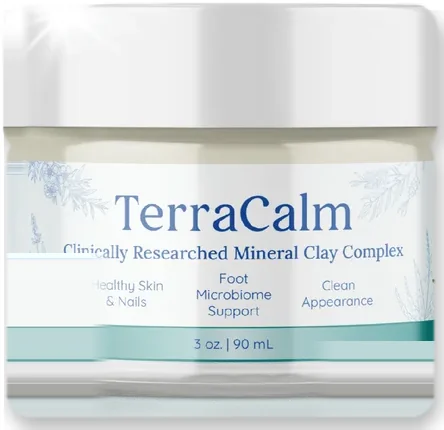
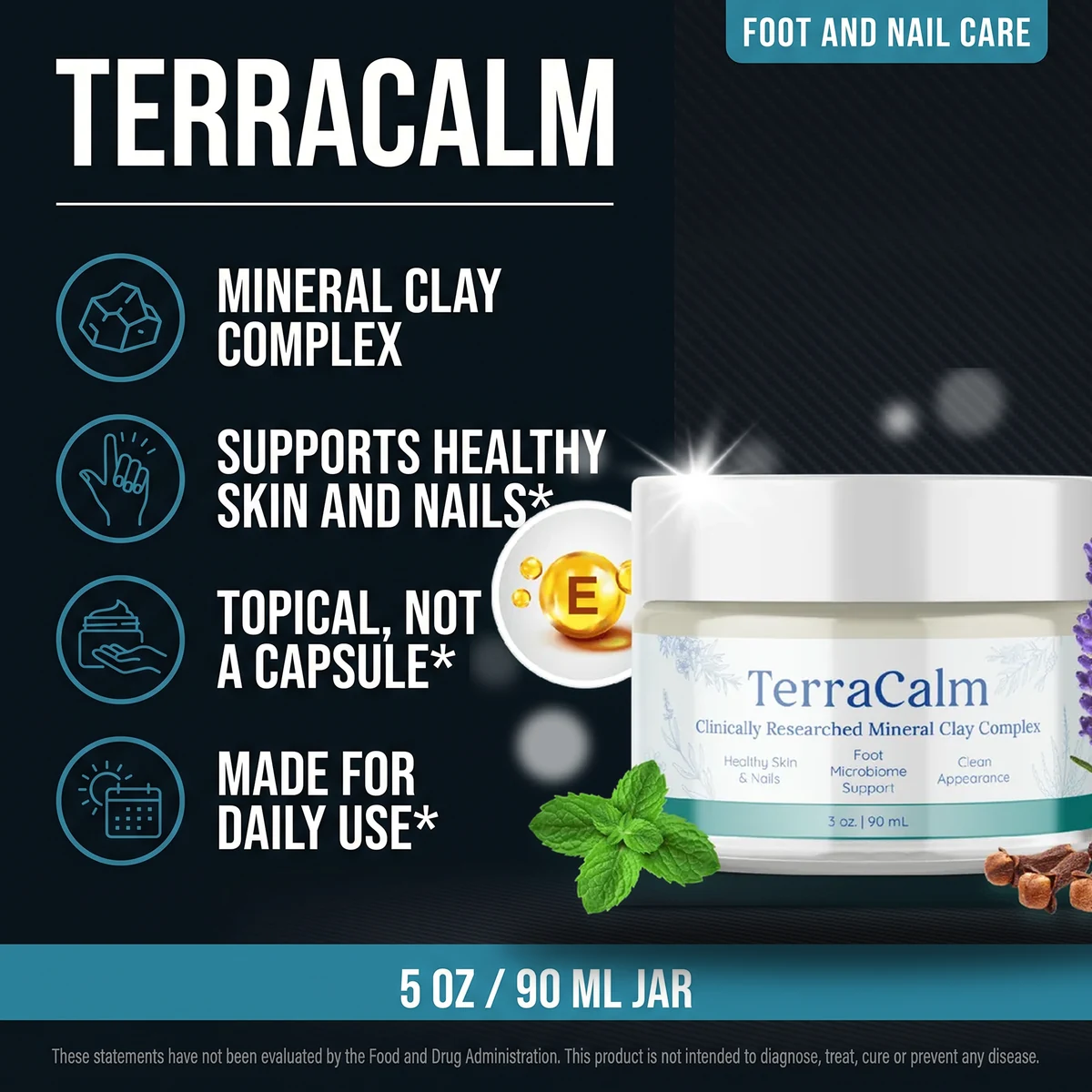
Thick toenails are far easier to manage — and far less likely to catch and tear — when the nail and the skin around it are kept soft and conditioned. TerraCalm is a once-daily topical mineral clay complex with clove, tea tree, oregano and skin-loving oils like vitamin E, aloe and shea butter, designed for exactly this kind of everyday foot and nail care. It is a cosmetic conditioner, not a treatment — but it makes a daily routine simple. Backed by a 60-day guarantee.
How to safely soften and manage thick toenails at home
You cannot reverse thickening overnight, but you can keep thick nails comfortable, tidy and easier to trim. Work gently — the goal is management, not aggressive cutting:
- ✓ Soak first. Ten to fifteen minutes in warm water softens the nail so it is far easier to trim and file.
- ✓ Dry thoroughly. Dry between the toes especially — trapped moisture is what feeds fungus.
- ✓ Trim straight across. Use sturdy, clean clippers and cut in small pieces, never rounding down the sides.
- ✓ File the surface. Gently file the top of the nail to reduce bulk, a little at a time on separate days.
- ✓ Moisturise daily. Conditioning the nail and skin keeps them more pliable and comfortable in shoes.
- ✓ Choose roomy shoes. A wide toe box stops the ongoing pressure that thickened the nail in the first place.
If a nail is extremely hard, painful, ingrown or crumbling, do not force it — a podiatrist can safely reduce and manage thick nails, which is especially important if you have diabetes or circulation problems.
Where conditioning care fits
Managing thick toenails is mostly about pressure relief, careful trimming and keeping everything soft, and the skin and nail benefit from daily conditioning. Botanical oils and butters such as vitamin E, aloe, shea, jojoba and sweet almond keep the nail and surrounding skin supple, while clove, tea tree and oregano are traditionally valued in foot care, and mineral clays like bentonite and kaolin help maintain a clean, balanced surface. A once-daily routine with TerraCalm keeps that care effortless, so thick nails stay softer, tidier and less prone to catching. Pair it with the wider routine in how to keep your nails healthy and strong.
When thick toenails deserve a doctor’s eye
See a doctor or podiatrist if a thick nail becomes painful, is lifting or crumbling, changes colour markedly, develops a dark streak, or if the thickening spreads to several nails and looks fungal. People with diabetes, nerve problems in the feet or poor circulation should have thick or problem toenails managed professionally rather than cutting aggressively at home, because a small injury can become a bigger problem. Sudden thickening of a single nail after an injury is usually just trauma, but any nail change you cannot explain is worth a check.
Start Your Daily Foot-Care Ritual
What the research says about thickened toenails
Thickening is one of the best-documented changes in the ageing nail. A study of nail changes in elderly patients in the Journal of Cosmetic Dermatology found thickening and discolouration among the most frequent findings with age, which is why a toenail can become harder to cut without anything having gone wrong El-Domyati et al., 2014.
Repeated pressure produces the same result at any age. A 2026 clinical review in the Journal of the American Academy of Dermatology groups these under mechanical and structural nail disorders and describes how chronic microtrauma from footwear thickens and distorts the plate Ricardo et al., 2026. That matters because a thickened, damaged nail is also more susceptible to fungal invasion: a paper in the Journal of the European Academy of Dermatology and Venereology identified trauma, age, diabetes and circulatory disease among the risk factors that mark someone out for active prevention Tosti et al., 2005. Only a clinician can tell you which of these you are looking at.
Thick nails and hard skin usually arrive together, because both are the foot responding to pressure with more keratin. If the skin at the back of your foot has gone the same way, the reasons heels crack and go dry cover the other half of the same story.
Frequently asked questions
Why are my toenails so thick and hard?
Thick, hard toenails usually build up for everyday reasons: nails naturally thicken with age, repeated pressure from tight or narrow shoes, small repeated injuries from running and sport, reduced circulation to the feet, and a fungal element that thickens and crumbles the nail. Often more than one cause is at work at once, and the change happens gradually over months or years.
How do you soften thick toenails?
Soak the feet in warm water for ten to fifteen minutes to soften the nail, dry thoroughly, then carefully file the top surface down and trim straight across with sturdy clippers in small pieces. Moisturising the nail and surrounding skin daily keeps them more pliable. Never dig down the sides, and if the nail is very hard, painful or crumbling, a podiatrist can safely reduce it.
Are thick toenails always a fungus?
No. Thickening is very often simply age, footwear pressure or repeated minor trauma with no infection involved. A fungal cause is common too and tends to come with yellow-brown discolouration, crumbling and a musty smell. Because the look overlaps, it is worth having a persistently thick, discoloured nail assessed rather than guessing.
Can tight shoes cause thick toenails?
Yes. Shoes that are too tight, too short or too narrow press repeatedly on the nail, and that constant low-level trauma can make the nail thicken and lift over time. Runners and hikers see this often on the big and second toes. Well-fitted shoes with a roomy toe box are one of the simplest ways to prevent it getting worse.
Will a thick toenail ever go back to normal?
It depends on the cause. If tight shoes or a one-off injury caused it and the matrix was not permanently damaged, the nail can grow out thinner over many months once the pressure is removed. If age or long-standing changes are behind it, the nail may stay thicker, but good trimming and conditioning keep it comfortable and tidy. Toenails grow slowly, so give any improvement plenty of time.
Does TerraCalm help thick toenails?
TerraCalm is a cosmetic topical mineral clay complex for everyday foot and nail care. It does not treat any nail condition or infection, but conditioning the nail and surrounding skin keeps them softer and better cared for as part of a daily routine, and it is not intended to diagnose, treat, cure or prevent any disease.
References
- El-Domyati M, et al. “Nail changes and disorders in elderly Egyptians” Journal of Cosmetic Dermatology, 2014. PMID 25399619
- Ricardo JW, et al. “Evaluation and management of mechanical and structural nail disorders: A clinical review” Journal of the American Academy of Dermatology, 2026. PMID 41242632
- Tosti A, et al. “Patients at risk of onychomycosis—risk factor identification and active prevention” Journal of the European Academy of Dermatology and Venereology, 2005. PMID 16120200
- American Academy of Dermatology. “12 nail changes a dermatologist should examine.” aad.org
- Mayo Clinic. “Nail fungus – symptoms and causes.” mayoclinic.org
- NHS. “Thickened toenails.” nhs.uk
- MedlinePlus (U.S. National Library of Medicine). “Nail abnormalities.” medlineplus.gov
The TerraCalm Research Team is an independent group that writes plain-language, evidence-aware guides on everyday foot, skin and nail care. We read primary dermatology and public-health sources, describe ingredients in terms of their traditional and general use, and are careful to separate cosmetic care from medical treatment. Our articles are reviewed for accuracy before publishing and are intended for general education — not as a diagnosis or a substitute for your own clinician’s advice.
† These statements have not been evaluated by the Food and Drug Administration. This product is not intended to diagnose, treat, cure or prevent any disease. This article is for general information only and is not medical advice; consult a qualified professional about your individual situation.