How to Keep Your Nails Healthy and Strong: A Daily Care Guide
| What matters | Healthy nails come from consistent daily care, gentle handling and the right nutrients — not just polish or the occasional pedicure. |
| Watch for | Dryness, brittleness and neglected cuticles. Small daily habits add up faster than one-off fixes. |
| Topical support | Mineral clays and botanicals such as tea tree are traditionally used to help keep the skin and nails around your feet clean and comfortable. |
Strong, healthy-looking nails rarely happen by accident. Nails are living structures made of a tough protein called keratin, and the way they look today reflects the care — or neglect — of the past few weeks. The good news is that the fundamentals are simple, inexpensive and entirely within your control. This guide walks through the daily habits, the nutrients your nails are built from, and the role the skin around your nails plays in keeping them looking their best.
Your nails are a mirror of your daily habits
Each nail grows from a root tucked under the skin at the base, sliding forward over the nail bed as new keratin is produced. Fingernails grow roughly three millimetres a month; toenails grow more slowly still. Because that pace is so gradual, whatever you do to your nails today won’t fully show for weeks — which is exactly why a steady routine beats the occasional rescue mission.
The cuticle deserves special mention. That thin band of skin at the base of each nail is not a flaw to be trimmed away; it is a living seal that keeps moisture in and irritants out. Protecting it is one of the easiest ways to support the whole nail.
Six daily habits that keep nails healthy
None of these are complicated. The value is in doing them consistently.
- ✓ Keep them clean and dry. Fungi and bacteria favour damp, enclosed spaces, so dry thoroughly between the toes after washing.
- ✓ Trim straight across. For toenails especially, cutting straight and not too short helps reduce the chance of painful ingrown edges.
- ✓ Be gentle with cuticles. Push them back softly after a shower rather than cutting them, and keep them moisturised.
- ✓ Moisturise nails and skin. Nails and the skin around them lose water easily; a daily conditioning step helps them stay supple rather than brittle.
- ✓ Protect from harsh chemicals. Wear gloves for cleaning and dishwashing, and give nails breaks from heavy polish and acetone removers.
- ✓ Let your feet breathe. Rotate shoes, choose breathable socks and air your feet daily so moisture doesn’t build up.
The nutrients your nails are built from
Because nails are made of protein, what you eat provides the raw material for every new millimetre. No single food is a magic bullet, but a few nutrients are closely associated with nail and skin health:
Protein supplies the amino acids that become keratin. Biotin (vitamin B7) is one of the most studied nutrients for nail firmness. Iron and zinc support normal growth, and shortfalls sometimes show up first as ridged or brittle nails. Vitamin E and omega-3 fatty acids are linked with skin conditioning and moisture. And plain hydration matters too — well-hydrated skin around the nail is more resilient.
A varied, whole-food diet covers most of this for most people. Supplements can help fill genuine gaps, but they work best alongside good food, not instead of it. If you suspect a deficiency, a quick conversation with your doctor is worth more than guesswork.
Give your feet and nails a daily ritual
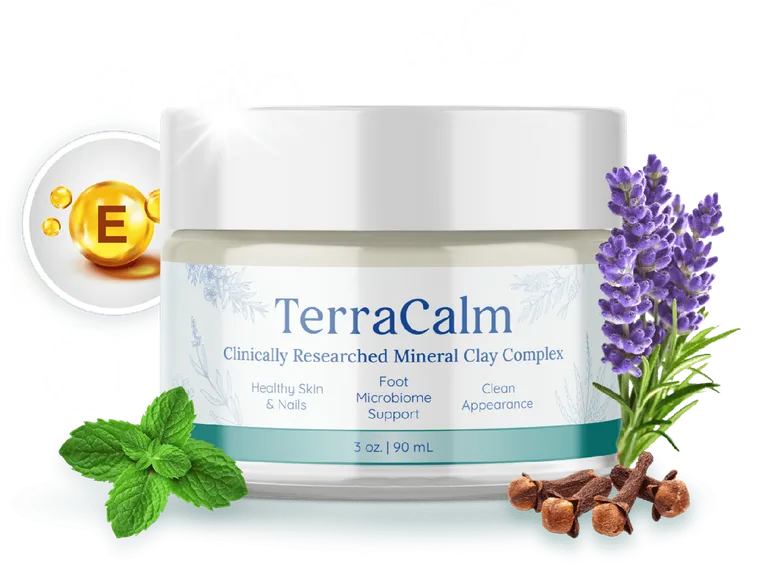
TerraCalm is a once-daily topical mineral clay complex — bentonite and kaolin clays, tea tree, clove and oregano oils and a soothing botanical blend — made to support healthy-looking skin and nails. Backed by a 60-day guarantee.
See TerraCalm PackagesDon’t forget the skin and microbiome around your nails
Nails don’t exist in isolation. They sit within skin that, on the feet, spends much of the day in a warm, enclosed, sometimes damp environment — conditions that make a clean, balanced skin surface harder to maintain. That is where topical care earns its place.
Mineral clays such as bentonite and kaolin are traditionally used to help draw out impurities and absorb excess surface moisture. Botanicals like tea tree, clove and oregano oils have a long history in foot care for supporting a clean, balanced environment, while conditioning oils — aloe, shea butter, jojoba and vitamin E — soften and soothe the skin around the nail. Combining those roles in one daily step is precisely the idea behind a formula like TerraCalm.
A simple foot-and-nail routine you’ll actually keep
The best routine is the one you don’t abandon. Keep it short:
- 1Evening: wash and dry. Clean your feet and dry carefully between the toes.
- 2Condition once daily. Massage a small amount of a topical clay or conditioning balm over the nails, cuticles and surrounding skin.
- 3Trim and tidy weekly. Cut straight across, gently push cuticles back, and check for any changes.
Common mistakes that hold your nails back
A few habits quietly work against you. Over-filing and aggressive buffing thin the nail plate. Picking or biting damages both the nail and the protective cuticle. Ignoring dryness lets nails turn brittle and prone to splitting. Wearing tight shoes or leaving damp socks on for hours creates exactly the environment nails don’t like. And, most common of all, doing everything right for a week and then stopping — consistency is the ingredient people skip most.
When to check with a professional
Everyday care handles appearance and comfort, but it is not a substitute for medical advice. If you notice persistent discolouration, thickening, separation from the nail bed, ongoing pain, or any change that doesn’t settle, see a physician or podiatrist. People with diabetes or circulation concerns should be especially attentive to foot and nail changes and follow their clinician’s guidance.
Start Your Daily Foot & Nail Ritual
The evidence behind a daily nail routine
Most of what makes a nail routine work is unglamorous, and the literature agrees. A review of brittle nails in Dermatology and Therapy identifies repeated wetting and drying as the dominant mechanical cause of splitting and peeling, and puts hydration and protection ahead of any supplement in the order of things to fix Chessa et al., 2020.
On the supplement question, a 2025 review in Skin Appendage Disorders sets out when oral nail products are reasonable and when they are not, and the honest summary is that they help where a genuine deficiency exists and rarely otherwise Zaraa et al., 2025. And a review of common nail disorders in Annals of Medicine is a useful reminder that a nail which is changing rather than simply weak — discolouring, thickening, lifting or painful — is a clinical question that a care routine cannot answer Lee & Lipner, 2022.
A good routine also means knowing which of your own complaints is which. If the frustration is pace rather than strength, the reasons nails grow slowly are mostly age, circulation and season rather than anything you are doing wrong. If the plate bends instead of breaking, that is the separate problem of thin, bendy nails. And if the only issue is a scattering of pale marks, white spots on nails need patience rather than a new product.
Frequently asked questions
How long does it take to see healthier-looking nails?
Nails grow slowly — fingernails around 3 mm a month and toenails more slowly still — so visible change is gradual. Consistent daily care over several weeks tends to show up before any single quick fix does, which is why building a routine matters more than an occasional treatment.
Are mineral clays good for the feet and nails?
Mineral clays such as bentonite and kaolin are traditionally used in topical care to help draw out impurities and absorb excess moisture on the skin surface. In a foot context, that can help keep the warm, enclosed environment around the toes and nails feeling clean and balanced.
Should I cut my cuticles?
Most dermatology guidance suggests leaving cuticles intact rather than cutting them, because the cuticle acts as a seal that protects the nail. Gently pushing them back after a shower and keeping them moisturised is usually enough.
Can diet really affect my nails?
Nails are built from keratin, a protein, so a balanced diet with adequate protein, plus nutrients like biotin, iron, zinc and vitamin E, gives your body the raw materials to grow healthy nails. Supplements may help fill gaps but are not a substitute for a varied diet.
Is TerraCalm a treatment for nail conditions?
No. TerraCalm is a cosmetic topical mineral clay for everyday skin, nail and foot care and is intended to support a healthy-looking, clean appearance. It is not intended to diagnose, treat, cure or prevent any disease. If you have a persistent nail concern, see a physician or podiatrist.
References
- Chessa MA, et al. “Pathogenesis, Clinical Signs and Treatment Recommendations in Brittle Nails: A Review” Dermatology and Therapy (Heidelberg), 2020. PMID 31749091
- Zaraa I, et al. “Nail Supplements: When, How, and Why?” Skin Appendage Disorders, 2025. PMID 40176998
- Lee DK, Lipner SR. “Optimal diagnosis and management of common nail disorders” Annals of Medicine, 2022. PMID 35238267
- American Academy of Dermatology. “How to care for your nails.” aad.org
- Mayo Clinic. “Nails: Do’s and don’ts for healthy nails.” mayoclinic.org
- National Institutes of Health, Office of Dietary Supplements. “Biotin — Fact Sheet for Consumers.” ods.od.nih.gov
- American Academy of Dermatology. “12 nail changes a dermatologist should examine.” aad.org
† These statements have not been evaluated by the Food and Drug Administration. This product is not intended to diagnose, treat, cure or prevent any disease. This article is for general information only and is not medical advice; consult a qualified professional about your individual situation.